Yes. Your inner ear contains the vestibular system, which tells your brain where your head is and how it is moving. When it stops sending accurate signals, you feel dizzy, unsteady or like the room is spinning. Inner ear problems are one of the most common causes of dizziness, and most are treatable once identified.
Most people know the ear as the organ of hearing. Fewer know that the same small space inside your skull also runs your balance.
We see clients every week who are surprised to learn the two are connected, usually after months of being told their dizziness is unexplained. Often it is not unexplained at all.
What is the vestibular system?
If your hearing system processes sound, your vestibular system is your internal navigation. It sits in the inner ear alongside the hearing organ and tells your brain whether you are moving, tilting or standing still, so your body can make constant small corrections without you thinking about it.
It has three parts:
Semicircular canals. Three looped, fluid-filled tubes that sense rotation, like turning your head or rolling over in bed.
Otolith organs. Two small sacs that detect gravity and straight-line movement, like standing up, accelerating in a car or riding in a lift.
Vestibular nerve. Carries all of that information to the brain, running alongside the hearing nerve.
When the system is healthy, your brain gets a clear and accurate picture. When infection, injury or age-related change distorts those signals, your brain receives information that conflicts with what your eyes and body are reporting. That conflict is what you experience as dizziness.
How are hearing and balance connected?
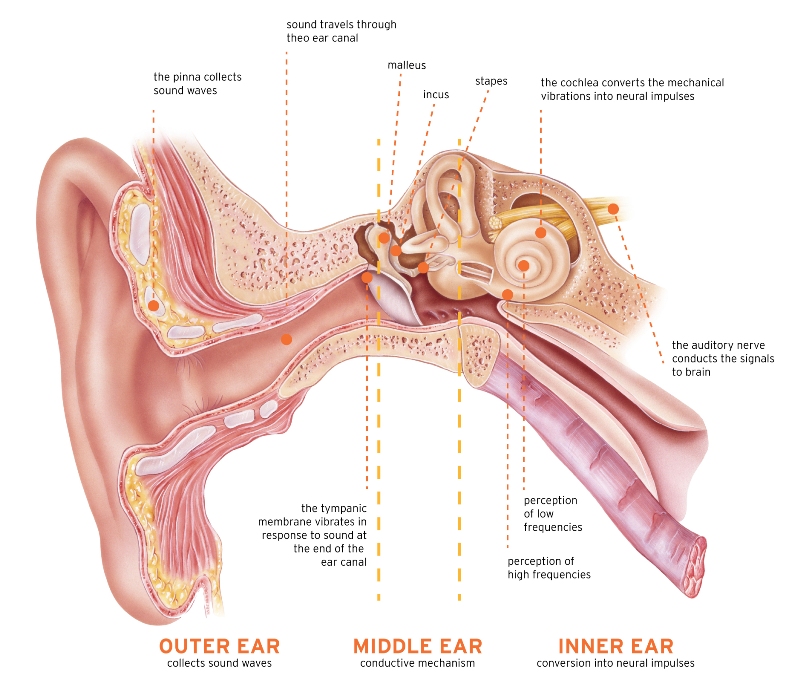
Because they share the same real estate. The hearing organ and the balance organs sit in the same fluid-filled space in the inner ear, and their nerves travel to the brain together.
So a problem affecting one frequently affects the other:
- Ear infections and inflammation can damage both hearing and balance structures
- Meniere’s disease causes vertigo, hearing loss and tinnitus together
- Age-related change affects both sound processing and stability
- An acoustic neuroma on the hearing nerve often causes unsteadiness alongside one-sided hearing loss and tinnitus
This is why dizziness combined with any change in your hearing, ringing in one ear or a feeling of pressure deserves proper assessment rather than watching and waiting.
What does an inner ear balance problem feel like?

It varies more than people expect. Common descriptions include:
- Vertigo, a spinning sensation, either of yourself or the room
- Light headedness or a floating feeling
- Unsteadiness when walking, or veering to one side
- Nausea, or feeling motion sick without moving
- Difficulty focusing your eyes when you turn your head
- A sense that the ground is not quite where you expect it
Symptoms may last seconds, hours or days, and are often triggered by specific movements such as rolling over in bed, looking up or bending down. That pattern is diagnostically useful, so it is worth noting what sets yours off before your appointment.
What are the common causes?
BPPV. Benign paroxysmal positional vertigo, where displaced crystals in the semicircular canals cause brief, intense spinning with head movement. It is the most common cause of vertigo and it usually responds to a repositioning manoeuvre in a single appointment.
Vestibular neuritis and labyrinthitis. Inflammation of the balance nerve, usually following a viral illness. Sudden, severe and frightening, but it settles, and rehabilitation speeds up recovery.
Meniere’s disease. Episodes of vertigo with fluctuating hearing loss, tinnitus and a feeling of fullness in one ear.
Age-related change. Gradual loss of vestibular function, often with hearing loss, contributing to unsteadiness and falls risk rather than spinning.
Head or ear trauma. Injury can affect both the balance organs and the nerve.
There are also causes outside the ear entirely, including blood pressure, medication, neck problems, migraine and neurological conditions. Part of the point of an assessment is establishing which category you are in.
When should I seek help?
Most dizziness is not dangerous. But get emergency medical help immediately, by calling 000, if dizziness comes with any of the following:
- Sudden severe headache
- Weakness, numbness or drooping on one side of the face or body
- Difficulty speaking or slurred speech
- Double vision or sudden vision loss
- Chest pain, or fainting
These can indicate a stroke, and time matters. Separately, a sudden drop in hearing in one ear alongside dizziness needs same-day assessment.
Why getting assessed early matters
Balance problems are not just uncomfortable. They increase your risk of falls, and they quietly shrink your life. People stop driving at night, avoid stairs, decline invitations and stop exercising, usually without ever deciding to.
Early diagnosis matters because most vestibular conditions respond well to treatment, and because the treatment differs enormously depending on the cause. BPPV can resolve in one appointment. Vestibular neuritis needs rehabilitation. Meniere’s needs management. Guessing wastes months.
How is it diagnosed?
An audiologist can assess both your hearing and your vestibular function with specialised testing that measures how your balance organs and the reflexes connected to them are actually performing.
At Knox Audiology we tailor the assessment to your symptoms, so what we test depends on what you describe. From there we can either treat directly, refer you for vestibular rehabilitation, or refer you to an ENT specialist if a medical cause needs ruling out.
Book a balance and dizziness assessment
If you have been living with dizziness, vertigo or unexplained unsteadiness, it is worth finding out why. The cause is often simple to treat once identified.
Call 03 9800 5697 or book a hearing and balance assessment online.