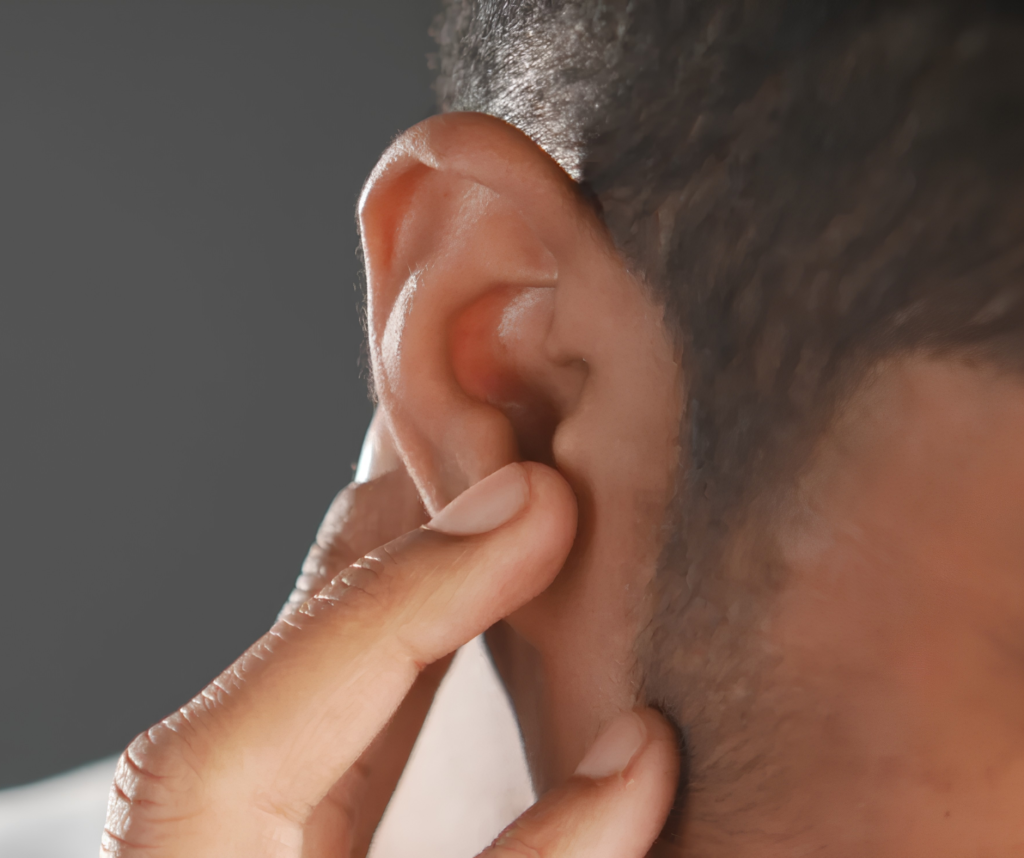

Hearing happens in four stages. The outer ear collects sound, the middle ear amplifies it, the inner ear converts it into nerve signals, and the brain makes sense of them. Hearing loss happens when one of those stages stops working properly, and which stage it is determines what can be done about it.
What does the outer ear actually do?
The part you can see, called the pinna, is not just a flap. Its ridges and folds funnel sound into the ear canal, and they do it directionally. That is why you hear someone standing in front of you more clearly than someone standing behind you, and it is part of how you work out where a sound is coming from without turning your head.
Sound travels down the ear canal and hits the eardrum, or tympanic membrane, at the end of it. The eardrum vibrates in response, moving differently depending on the pitch and volume of what hit it.
This is also the part of the ear most easily blocked. Wax, water or an infection in the canal will muffle everything before the sound gets any further in.
What happens in the middle ear?
Behind the eardrum sit the three smallest bones in the human body: the malleus, incus and stapes, sometimes called the hammer, anvil and stirrup.
They do two jobs. They carry the vibration across the middle ear to the inner ear, and they amplify it on the way. That amplification matters more than it sounds. The inner ear is full of fluid, and sound loses most of its energy moving from air into liquid. Without the middle ear boosting the signal first, much of what you hear would simply be lost at the crossover.
The last bone, the stapes, pushes against the oval window, which is the entrance to the cochlea.
How does the inner ear turn sound into hearing?
The cochlea is a fluid-filled, spiral-shaped organ about the size of a pea. When the stapes pushes on the oval window, it sends a wave through that fluid.
Where the wave peaks depends on pitch. High, sharp sounds create their biggest movement near the entrance of the spiral. Low, deep sounds travel further in, towards the centre. The cochlea is effectively sorting sound by frequency before the brain has seen any of it.
That movement shifts a structure called the basilar membrane, which activates thousands of tiny sensory cells known as hair cells. When a hair cell is activated, it fires a nerve impulse along the hearing nerve to the brain.
The whole sequence, from sound wave to recognisable speech, takes a few thousandths of a second. There is no lag in a conversation because there is no time for one.
Why can I hear people talking but not understand them?
This is one of the most common things we hear in the clinic, and the answer sits in the previous section.
Hair cells are tuned to different frequencies, and the ones responsible for high-pitched sound are usually the first to be damaged, whether by age or noise exposure. Consonants like s, f, th and k live in those high frequencies. Vowels live lower down.
So the volume of speech still reaches you, because the vowels are doing most of the carrying, but the detail that separates one word from another has gone. Speech sounds present but mumbled. Add background noise and it becomes guesswork.
That pattern is not a sign you are not concentrating. It is a measurable, specific loss, and it shows up clearly on a hearing test.
What can go wrong, and where?
Any of the three sections of the ear can be affected, and where the problem sits changes everything about how it is treated.
Outer and middle ear problems block or reduce sound on its way in. Wax build-up, fluid behind the eardrum, a perforation, or a problem with the middle ear bones. This is called conductive hearing loss. It is often temporary and frequently treatable, sometimes in a single appointment.
Inner ear problems mean the sound arrives but is not converted properly, usually because hair cells have been damaged. This is sensorineural hearing loss. Hair cells do not regenerate, so this type is permanent. It is also the most common type in adults, and it is what hearing aids are designed for.
Some people have both at once, which is called a mixed hearing loss.
Why does ear trouble affect balance and cause ringing?
Because the inner ear does two jobs, not one.
Sitting alongside the cochlea is the vestibular system, the body’s balance organ. It shares the same fluid, the same nerve pathway and the same blood supply. So a problem in the inner ear can show up as dizziness or unsteadiness rather than, or as well as, a hearing change.
Tinnitus, the ringing or buzzing many people notice in quiet rooms, is also linked to inner ear damage. When hair cells stop sending their usual signal, the brain often generates its own sound to fill the gap. It is not imagined, and it usually points to something worth assessing.
What should I do if something doesn’t feel right?
Start with a hearing assessment. It is the only way to identify which part of the ear is involved, and that distinction determines whether you are looking at a quick fix or a longer-term plan.
Worth booking sooner rather than later if you notice:
- Speech sounding muffled, particularly in groups or noisy rooms
- A blocked or full feeling that doesn’t clear
- Ringing, buzzing or hissing in one or both ears
- Dizziness or unsteadiness
- A change in one ear only
Sudden hearing loss in one ear is a medical urgency. If your hearing drops noticeably in one ear over hours or days, call us the same day rather than waiting to see if it settles.
Our audiologists run a full assessment, explain what the results mean in plain language, and tell you what your options are, including when the answer is that nothing needs doing.
Book a hearing assessment on 03 9800 5697, or request an appointment online.