
Very urgent. Treat sudden hearing loss in one ear as a medical emergency. Guidelines recommend starting corticosteroid treatment within two weeks of the hearing loss beginning, and the earlier within that window the better. If it has already been longer than two weeks, you should still be seen, because salvage treatment is recommended up to six weeks. Do not wait to see whether it improves on its own.
What to do right now
- Call us on 03 9800 5697 and say you have sudden hearing loss in one ear. Ask for an urgent appointment. If we cannot see you quickly enough, we will tell you where to get help.
- If you cannot get an appointment today, go to your GP or a hospital emergency department. This is a legitimate reason to present, and being seen today matters more than being seen by us.
- Do not wait for it to clear. The most common and most costly mistake is assuming it is wax or a cold and giving it a week.
Call 000 if your hearing loss comes with weakness or numbness on one side, drooping of the face, slurred speech, sudden severe headache, sudden vision loss, or dizziness so severe you cannot stand or walk. Milder dizziness or a spinning sensation is common with sudden hearing loss and is not itself a reason for an ambulance, but it is a reason to be seen today.
What is sudden sensorineural hearing loss?
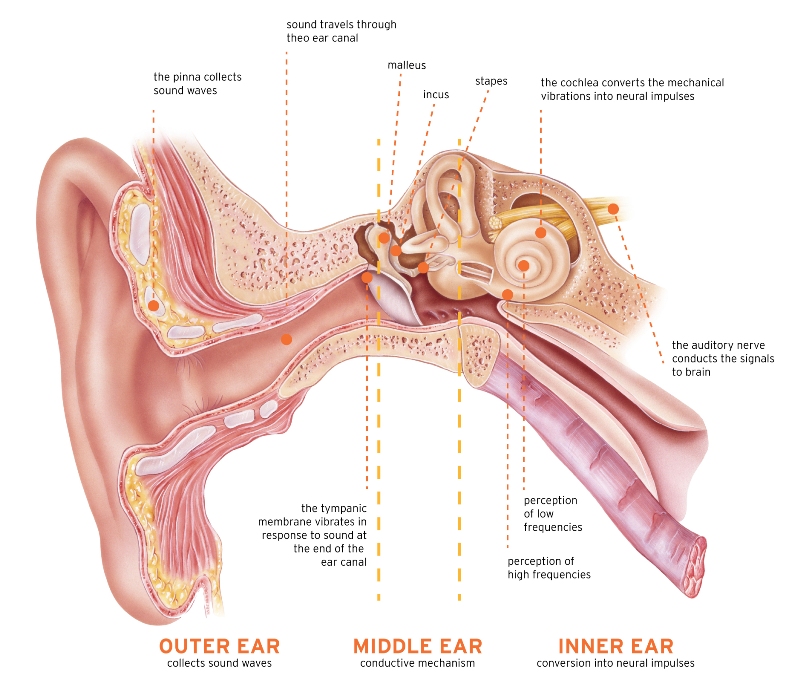
Sudden sensorineural hearing loss, usually shortened to SSNHL, is a rapid loss of hearing affecting the inner ear or the hearing nerve. It almost always affects one ear only.
People describe it in a few consistent ways: waking up and finding one ear has gone, noticing an immediate change during the day, sometimes with a pop, or a clear decline over two or three days. The affected ear usually feels blocked, and hearing in it is muffled, significantly reduced or absent altogether.
Many people also notice tinnitus in that ear, or a feeling of fullness, and some have dizziness with it.
How urgent is it, really?
Urgent enough that it is treated as an emergency by audiologists and ENT specialists.
The reason is the treatment window. The usual treatment is a course of corticosteroids, and guidelines recommend starting within two weeks of the hearing loss beginning. Earlier is better within that window.
If it has been longer than two weeks, that does not mean you have missed out. Guidelines recommend salvage treatment, usually steroids injected through the eardrum, for people who have not fully recovered between two and six weeks after onset. Do not decide on your own that it is too late to bother.
Around half of people recover some or all of their hearing on their own, usually within the first week or two. That sounds like a reason to wait, and it is not, because there is no way to tell in advance which half you are in. If you turn out to be in the other half, the window has closed while you were finding out.
There is no version of this where waiting is the better option.
Why is it so often mistaken for something harmless?
Because a blocked, muffled ear is also what earwax feels like. And a middle ear problem after a cold, or Eustachian tube dysfunction, or fluid behind the eardrum. All of those are common, harmless and resolve on their own.
From the outside, and from the inside, they can feel identical. The difference is that one of them has a treatment window measured in days and the others do not.
This is precisely why assessment matters rather than self-diagnosis. A hearing test distinguishes between them in minutes. If it turns out to be wax, that is good news and we can remove it the same day.
What causes sudden hearing loss?
In most cases, no definite cause is ever identified, which is unsatisfying but does not change the treatment.
Where a cause is found, the usual candidates are:
- Viral infection affecting the inner ear
- Circulatory changes, including reduced blood flow to the inner ear
- Head or ear trauma
- Reactions to certain medications, known as ototoxicity
- Inner ear conditions such as Meniere’s disease
- Autoimmune and immune-related conditions
- Rarely, an acoustic neuroma on the hearing nerve
Because a small number of causes need medical investigation, prompt assessment does two jobs: it starts treatment, and it identifies anything that needs following up.
What does treatment involve?
The usual treatment is a course of corticosteroids, given as tablets or by injection through the eardrum. Guidelines describe steroids as an option rather than a certainty: the studies are limited and specialists do not all agree how much difference they make. What is agreed is that if they are going to help, they need to be started early, which is why the assessment is urgent even though the treatment is not guaranteed.
Our role is to establish quickly and accurately what has happened to your hearing, which determines whether you need urgent medical referral, and to provide the baseline that everything afterwards is measured against. We can usually do that same day.
Will my hearing come back?
Sometimes fully, sometimes partly, sometimes not at all. Around half of people recover some or all of their hearing, and outcomes depend on how severe the loss was, whether dizziness was involved, your age, and how quickly treatment started.
What is consistent across the research is the direction of that last factor. Earlier treatment gives better outcomes. That is the one part of this you have any control over, and it is the reason this page exists.
If hearing does not fully return, there are good options, including devices designed specifically for hearing loss in one ear. But that conversation comes later. Today the priority is getting seen.
Call now for an urgent appointment
If you have had a sudden drop in hearing in one ear, we will fit you in for an urgent hearing assessment. Tell reception it is sudden hearing loss so your call is prioritised.
Call 03 9800 5697 and request an URGENT appointment.